
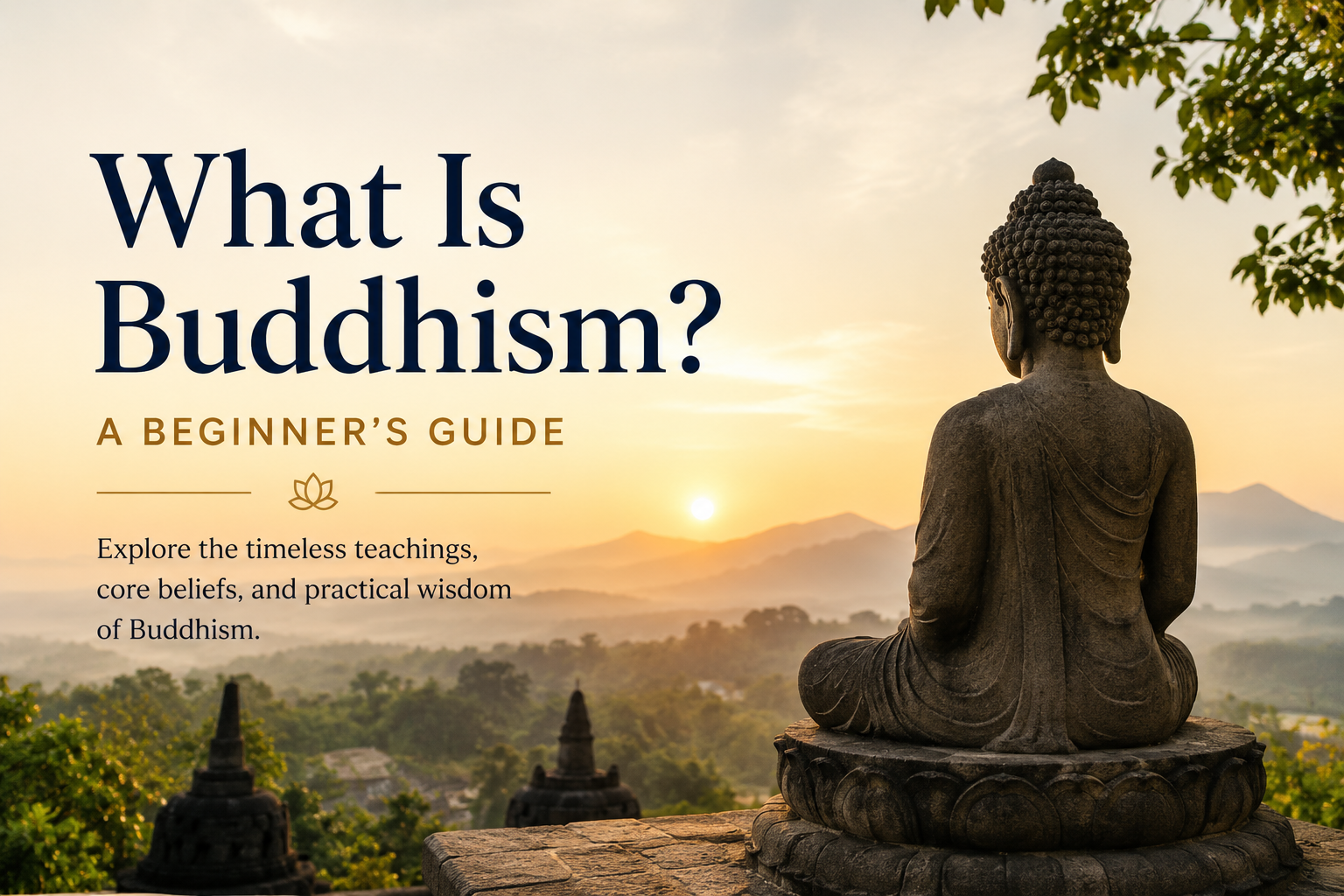
If you’ve ever wondered What is Buddhism?, you’re not alone.
For some people, Buddhism is a religion. For others, it is a philosophy or a practical way of understanding the mind and approaching everyday life with greater awareness. Millions of people around the world follow Buddhist traditions, while many others simply draw inspiration from its teachings on mindfulness, compassion, and wisdom.
At its heart, Buddhism explores one fundamental question: why do people suffer, and how can they find lasting peace?
This beginner’s guide introduces the basic ideas behind Buddhism and explains why its teachings continue to resonate more than 2,500 years after they first emerged.
What Is Buddhism?
Buddhism is a spiritual tradition that originated in ancient India through the teachings of Siddhartha Gautama, who later became known as the Buddha, or “the Awakened One.”
Rather than asking followers to accept beliefs without question, Buddhism encourages personal observation, reflection, and direct experience.
Its teachings focus on understanding the nature of the mind, recognizing the causes of suffering, and cultivating qualities such as compassion, ethical conduct, and mindfulness.
While there are many Buddhist schools and traditions, they share the common goal of helping people develop wisdom and reduce unnecessary suffering.
Who Was the Buddha?
Siddhartha Gautama is believed to have lived around the 5th century BCE in what is now Nepal and northern India.
Born into a privileged family, he eventually left behind a comfortable life after encountering old age, illness, and death. These experiences led him to search for a deeper understanding of the human condition.
After years of study and meditation, he attained enlightenment beneath the Bodhi tree and became known as the Buddha.
He spent the rest of his life teaching others a practical path toward inner freedom, establishing the foundations of what would become Buddhism.
What Do Buddhists Believe?
Although beliefs and practices vary across traditions, several core ideas appear throughout Buddhism.
One is that suffering and dissatisfaction are universal aspects of human life. Rather than avoiding this reality, Buddhism encourages understanding its causes and learning how to respond more wisely.
Another central teaching is impermanence—the idea that everything changes over time. Recognizing this can help reduce attachment and encourage greater appreciation for the present moment.
Buddhism also emphasizes compassion, ethical behavior, mindfulness, and personal responsibility. The concept of karmarefers to intentional actions and the consequences they create, rather than a system of supernatural rewards or punishments.
Together, these principles offer a framework for living with greater awareness and kindness.
Is Buddhism a Religion or a Philosophy?
The answer depends on perspective.
For many people, Buddhism is a religion with temples, rituals, ceremonies, and monastic communities.
Others approach it primarily as a philosophy or a practical guide for understanding the mind and improving daily life.
In many ways, Buddhism can be both.
Its teachings invite inquiry rather than blind faith, encouraging individuals to examine their own experiences and discover what leads to greater wisdom and compassion.
Because of this openness, many people study Buddhist ideas without formally identifying as Buddhists.
The Main Teachings of Buddhism
Although Buddhism contains a rich body of teachings, several themes appear repeatedly.
The Four Noble Truths explain the nature of suffering, its causes, and the possibility of liberation.
The Eightfold Path describes practical guidance for ethical living, mental discipline, and wisdom.
Mindfulness encourages paying attention to present-moment experience with clarity and curiosity.
Compassion and loving-kindness support healthier relationships with ourselves and others.
Together, these teachings are intended not as abstract philosophy but as practical tools for everyday life.
Why Do People Practice Buddhism Today?
People are drawn to Buddhism for many different reasons.
Some seek greater peace of mind during stressful periods of life. Others are interested in meditation, personal growth, or spiritual exploration.
Many appreciate that Buddhist teachings encourage self-reflection and emphasize personal experience over unquestioning belief.
Whether practiced within a religious tradition or simply as a source of practical wisdom, Buddhism offers perspectives that many people find helpful when navigating change, uncertainty, relationships, and everyday challenges.
Where to Begin
Starting to learn about Buddhism doesn’t require memorizing unfamiliar terminology or understanding every philosophical concept at once.
Building a strong foundation through clear, accessible explanations is often the best approach.
The Buddha Wisdom app includes a Beginner Learning Journey together with an Introductory Reading Collection designed to introduce essential Buddhist ideas step by step. Short daily readings and structured lessons make it easier to develop understanding gradually and connect timeless teachings with modern life.
A Journey of Curiosity and Practice
Buddhism is ultimately an invitation to explore.
Its teachings encourage curiosity, mindful observation, and compassion rather than rigid belief or dogma.
Whether you are interested in meditation, philosophy, or finding practical ways to navigate everyday challenges, learning about Buddhism can provide valuable perspectives that continue to inspire people around the world.
You don’t need to have all the answers before you begin. Taking the first step with an open mind may be the most important part of the journey.