
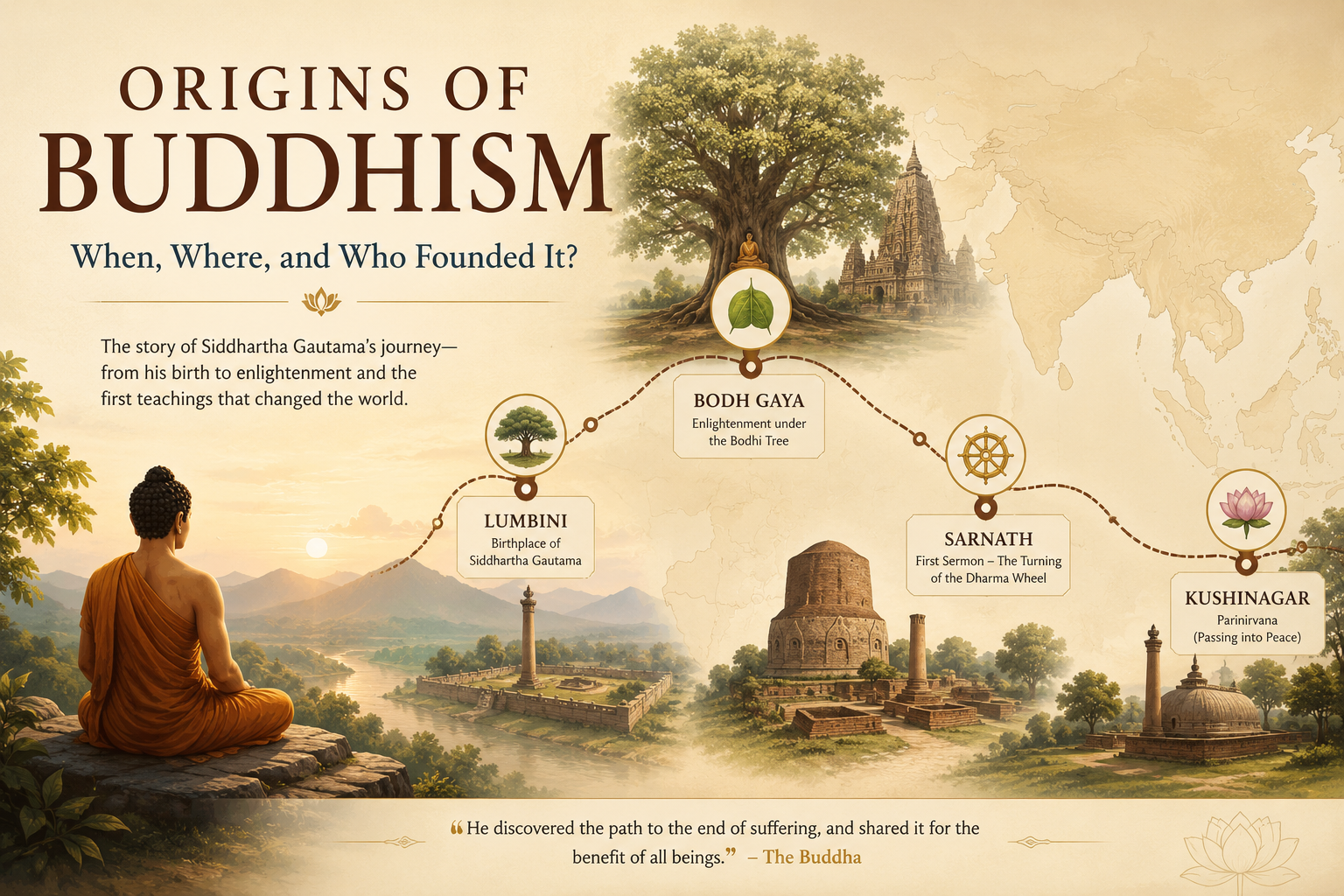
Buddhism is one of the world’s oldest and most influential spiritual traditions, practiced by millions of people across the globe. Its origins can be traced to the teachings of Siddhartha Gautama, who lived and taught in the northeastern Indian subcontinent more than 2,500 years ago.
At the heart of his search was a question that remains deeply relevant today:
Why do people suffer, and is it possible to find lasting freedom from suffering?
According to Buddhist tradition, Siddhartha Gautama devoted his life to investigating this question. After attaining awakening, he became known as the Buddha, meaning “the Awakened One,” and began teaching others what he had discovered.
The Historical Background of Ancient India
To understand the origins of Buddhism, it helps to look at the world in which it emerged.
Around the 5th century BCE, the northeastern Indian subcontinent was a region of political change, economic development, and active religious and philosophical debate. Various traditions and schools of thought coexisted, with teachers and spiritual seekers asking questions about suffering, rebirth, ethics, meditation, and the possibility of liberation.
Alongside established Brahmanical traditions, various Śramaṇa movements explored alternative approaches to spiritual practice and liberation. Wandering teachers and seekers experimented with meditation, ascetic practices, ethical discipline, and different ideas about the nature of human existence.
People were searching for answers to fundamental questions:
- Why do we suffer?
- What causes suffering?
- Is lasting happiness possible?
- Is there a path to freedom?
- How should a person live?
It was within this wider culture of religious and philosophical inquiry that Siddhartha Gautama began his search for an answer to suffering. His teachings would eventually develop into what became known as Buddhism.
Who Founded Buddhism?
Siddhartha Gautama is traditionally regarded as the founder of Buddhism. After attaining awakening, he became known as the Buddha, meaning “the Awakened One.”
According to Buddhist tradition, Siddhartha was born in Lumbini, in present-day Nepal, and was associated with the Shakya community. His early life is traditionally described as one of privilege and comfort, sheltered from many of the realities of suffering.
Everything changed when, according to Buddhist texts, he encountered what became known as the Four Sights:
- an elderly person
- a sick person
- a dead body
- and a wandering spiritual seeker
These encounters confronted Siddhartha with realities that affect every human life: aging, illness, death, and the search for a way beyond suffering.
Deeply moved, Siddhartha left his privileged life and began a spiritual search. He studied with teachers, practiced meditation and severe asceticism, and explored different approaches to liberation.
Eventually, he rejected both extreme indulgence and extreme self-denial. Instead, he pursued what became known as the Middle Way, a path between these two extremes.
When Was Buddhism Founded?
There is no exact date for the founding of Buddhism. Historians generally place its beginnings in the 5th century BCE, although the precise dating of the Buddha’s lifetime remains debated.
The earliest Buddhist teachings were transmitted orally for generations before being committed to writing. This makes it difficult to identify a single year when Buddhism began.
After years of spiritual practice, Siddhartha Gautama attained awakening while meditating beneath the Bodhi tree at Bodh Gaya, in present-day India. He became the Buddha and began teaching others what he had discovered.
His awakening marks an important beginning in the history of Buddhism, but the Buddhist tradition developed through the Buddha’s subsequent teachings and the community that formed around them.
According to Buddhist tradition, the Buddha gave his first teaching at Sarnath, near present-day Varanasi. This teaching introduced the Four Noble Truths and the path leading toward liberation.
From this point, the Buddha began teaching more widely, attracting disciples and establishing the Sangha, the community that would preserve and practice his teachings.
Where Did Buddhism Originate?
Buddhism originated in the northeastern Indian subcontinent around the 5th century BCE. The region associated with the Buddha’s life and the earliest Buddhist community corresponds broadly to parts of present-day northern India and southern Nepal.
Buddhism therefore did not originate in a single modern city or country. Several locations across this region are traditionally associated with important events in the Buddha’s life:
- Lumbini – traditionally regarded as the birthplace of Siddhartha Gautama, in present-day Nepal
- Bodh Gaya – where the Buddha attained awakening, in present-day India
- Sarnath – where the Buddha delivered his first teaching, in present-day India
- Kushinagar – traditionally regarded as the place where the Buddha entered Parinirvana, in present-day India
Together, these places represent important stages in the traditional account of the Buddha’s life and the emergence of Buddhism.
How Buddhism Began to Spread
After his awakening, the Buddha spent approximately 45 years traveling and teaching throughout northern India.
He attracted followers from different social and economic backgrounds and established the Sangha, the community of monks and nuns dedicated to practicing and preserving his teachings. Lay followers also became an important part of the early Buddhist community.
The Buddha’s first teaching at Sarnath became an important starting point for the transmission of his teachings. As more people became his disciples, Buddhist teachings spread through networks of teachers, monastics, and lay communities.
During his lifetime, the Buddha traveled extensively and taught for decades. After his death, his teachings continued to be transmitted orally and preserved within the growing Buddhist community.
The spread of Buddhism accelerated significantly under Emperor Ashoka of the Mauryan Empire in the 3rd century BCE. After a period of military expansion, Ashoka became a major supporter of Buddhism and promoted Buddhist principles through patronage, inscriptions, and support for Buddhist communities.
Over the following centuries, Buddhism spread far beyond the region where it began, reaching many parts of Asia, including:
- Sri Lanka
- Myanmar
- Thailand
- China
- Korea
- Japan
- Tibet
- Mongolia
- Vietnam
- and many other regions
As Buddhism spread, local cultures and communities developed different practices, interpretations, and schools. These developments eventually contributed to the diverse Buddhist traditions found around the world today.
Why the Origins of Buddhism Still Matter Today
Learning about the origins of Buddhism is not simply an academic exercise.
Understanding where these teachings came from helps explain the questions that shaped the Buddhist path from the beginning.
The Buddha’s teachings addressed experiences that remain familiar to people today:
- suffering and dissatisfaction
- attachment
- fear
- change
- uncertainty
- and the possibility of greater freedom and peace
The historical context also helps explain why Buddhist teachings place such importance on understanding the mind, cultivating ethical conduct, and developing awareness.
Exploring the origins of Buddhism can therefore provide useful context for understanding teachings such as the Four Noble Truths, the Noble Eightfold Path, mindfulness, compassion, and meditation.
Beginning Your Own Exploration
The origins of Buddhism tell the story of Siddhartha Gautama’s search for an understanding of suffering, but they also provide an introduction to the teachings that developed from that search.
If you’re new to Buddhism, learning about the Buddha’s life and the early history of the tradition is a useful starting point. From there, concepts such as the Four Noble Truths, the Noble Eightfold Path, mindfulness, compassion, and meditation become easier to understand within their historical and philosophical context.
For those who prefer a structured approach, the Buddha Wisdom app includes a Beginner Learning Journey and carefully curated Foundations Readings that introduce key Buddhist ideas step by step. Rather than overwhelming new learners with philosophy, these guided resources provide an accessible way to build understanding gradually and explore Buddhist wisdom in everyday life.
A Tradition That Began With a Question
The origins of Buddhism are ultimately connected to a fundamental question: why do human beings suffer, and is freedom from suffering possible?
Siddhartha Gautama devoted his life to investigating that question. His awakening led to a body of teachings that was passed from teacher to student and developed into a tradition that has endured for more than 2,500 years.
From its beginnings in the northeastern Indian subcontinent, Buddhism spread across Asia and eventually around the world. Although Buddhist traditions differ in their practices and interpretations, they trace their origins to the teachings of the Buddha and the community that formed around them.
Whether you approach Buddhism as a spiritual path, a philosophy, or a source of practical wisdom, understanding its beginnings offers a useful first step into a much larger tradition.