
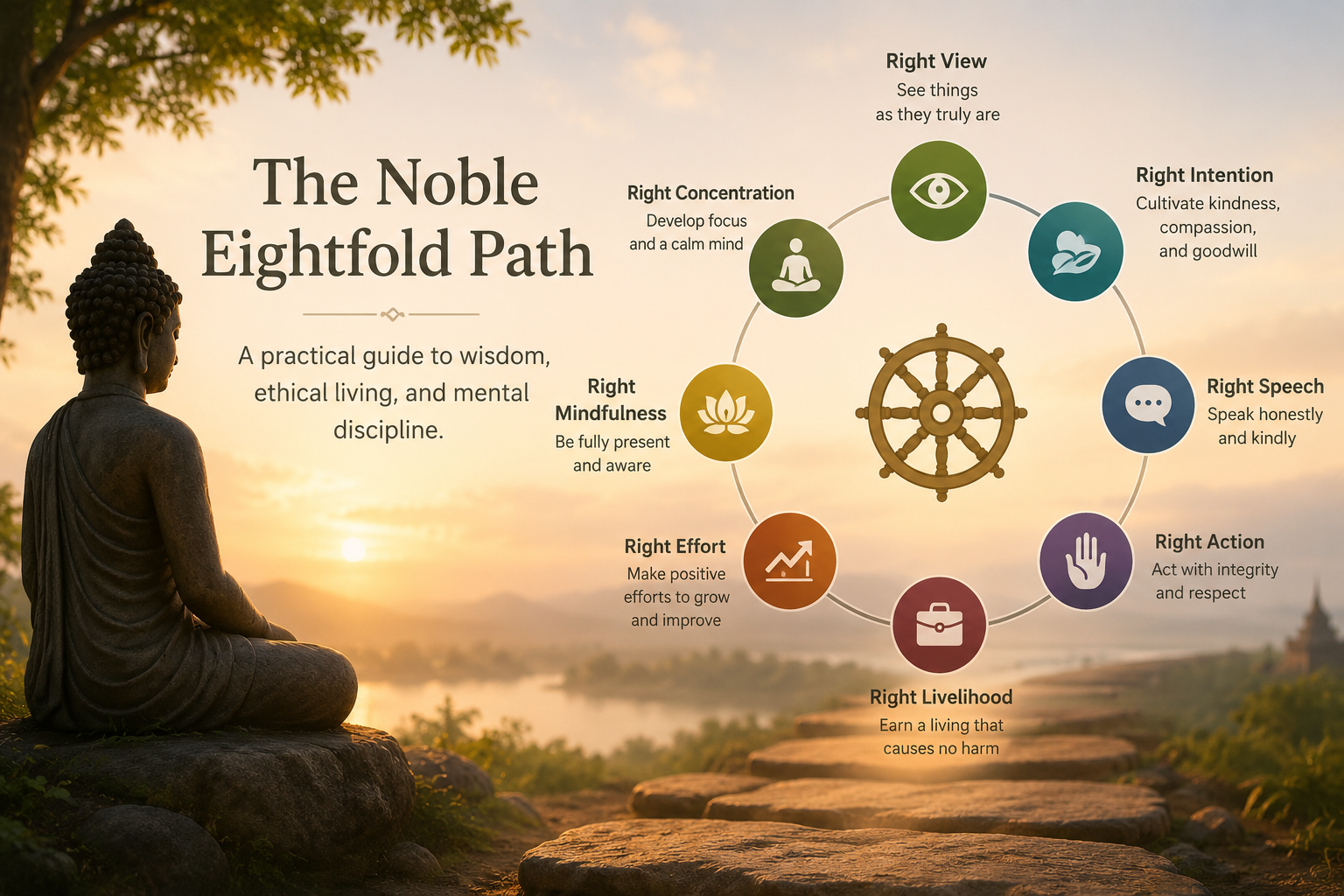
The Noble Eightfold Path is one of the central teachings of Buddhism. Rather than a list of commandments or strict rules, it is a practical guide for cultivating wisdom, ethical conduct, and mental discipline.
The Buddha introduced the Eightfold Path as the way to reduce suffering and move toward greater freedom and inner peace. It forms the fourth of the Four Noble Truths and offers practical steps that can be applied in everyday life.
Although it was first taught more than 2,500 years ago, its principles remain remarkably relevant in the modern world.
What Is the Noble Eightfold Path?
The Noble Eightfold Path is a framework for living with greater awareness and intention.
Its eight elements are traditionally grouped into three broader areas:
- Wisdom (Paññā)
- Ethical Conduct (Sīla)
- Mental Discipline (Samādhi)
These areas work together rather than separately. The goal is not to perfect one step before moving to the next but to gradually cultivate all aspects of the path over time.
How Does It Relate to the Four Noble Truths?
The Four Noble Truths explain the nature of suffering, its causes, the possibility of liberation, and the path leading toward that liberation.
The Noble Eightfold Path is that path.
Instead of simply identifying the problem, it provides practical guidance for transforming the way we think, speak, act, and relate to the world.
For this reason, many Buddhists see it as a roadmap for personal development rather than a set of religious obligations.
The Three Pillars of the Path
Wisdom
Wisdom focuses on seeing reality more clearly and developing intentions rooted in compassion and understanding.
It includes:
- Right View
- Right Intention
Together, these encourage us to question assumptions, understand cause and effect, and cultivate motivations that reduce rather than increase suffering.
Ethical Conduct
Ethical conduct concerns how we interact with other people.
It includes:
- Right Speech
- Right Action
- Right Livelihood
These principles encourage honesty, kindness, responsibility, and earning a living in ways that do not intentionally harm others.
Rather than imposing moral rules, Buddhism presents ethical behavior as a natural support for inner peace and healthy relationships.
Mental Discipline
Mental discipline develops the qualities needed to understand and transform the mind.
It includes:
- Right Effort
- Right Mindfulness
- Right Concentration
These practices help cultivate awareness, focus, and resilience while reducing habitual reactions that contribute to stress and dissatisfaction.
The Eight Factors Explained
Right View
Understanding reality with wisdom, including the recognition that actions have consequences and that life is shaped by change and interdependence.
Right Intention
Cultivating motivations based on goodwill, compassion, and letting go rather than anger, ill will, or harmful desires.
Right Speech
Using language truthfully and kindly while avoiding lies, gossip, harsh speech, and words that create unnecessary conflict.
Right Action
Acting ethically through respect for life, honesty, and responsible behavior toward others.
Right Livelihood
Choosing work that supports well-being and avoids causing intentional harm to people or other living beings.
Right Effort
Making a consistent effort to cultivate wholesome habits while reducing unhelpful mental patterns.
Right Mindfulness
Developing clear awareness of thoughts, emotions, bodily sensations, and present-moment experience without becoming overwhelmed by them.
Right Concentration
Training the mind to become more stable and focused through meditation and sustained attention.
Common Misconceptions About the Eightfold Path
One common misconception is that the Eightfold Path is a checklist to complete in order.
In reality, the eight factors support one another and are practiced together throughout life.
Another misunderstanding is that the path is only relevant for monks or dedicated practitioners.
Many of its principles—such as speaking honestly, acting compassionately, and developing mindfulness—can be applied in ordinary situations at home, at work, and in relationships.
Finally, the Eightfold Path is not about achieving perfection. It is a process of gradual learning and continuous practice.
Why the Eightfold Path Still Matters Today
Modern life often encourages constant distraction, competition, and the pursuit of external success.
The Noble Eightfold Path offers an alternative perspective.
By developing wisdom, ethical conduct, and mindfulness, people can build healthier relationships, respond more thoughtfully to challenges, and cultivate greater emotional balance.
Its value lies not in following rigid rules but in encouraging intentional choices that contribute to long-term well-being.
Where to Begin
You do not need to master all eight aspects of the path at once.
Many people begin by becoming more mindful in daily life, paying greater attention to their speech, or reflecting on the motivations behind their actions.
The Buddha Wisdom app includes a Beginner Learning Journey and an Introductory Reading Collection that introduce these teachings through short, structured lessons and daily reflections. Exploring one concept at a time makes it easier to understand how the Eightfold Path can become part of everyday life.
A Practical Path for Everyday Living
The Noble Eightfold Path is more than an ancient teaching.
It is a practical framework for cultivating wisdom, compassion, ethical behavior, and mindful awareness in a changing world.
Rather than promising instant transformation, it encourages steady progress through small, intentional choices.
Over time, these choices can shape not only how we respond to life’s difficulties but also how we experience greater clarity, resilience, and peace.