
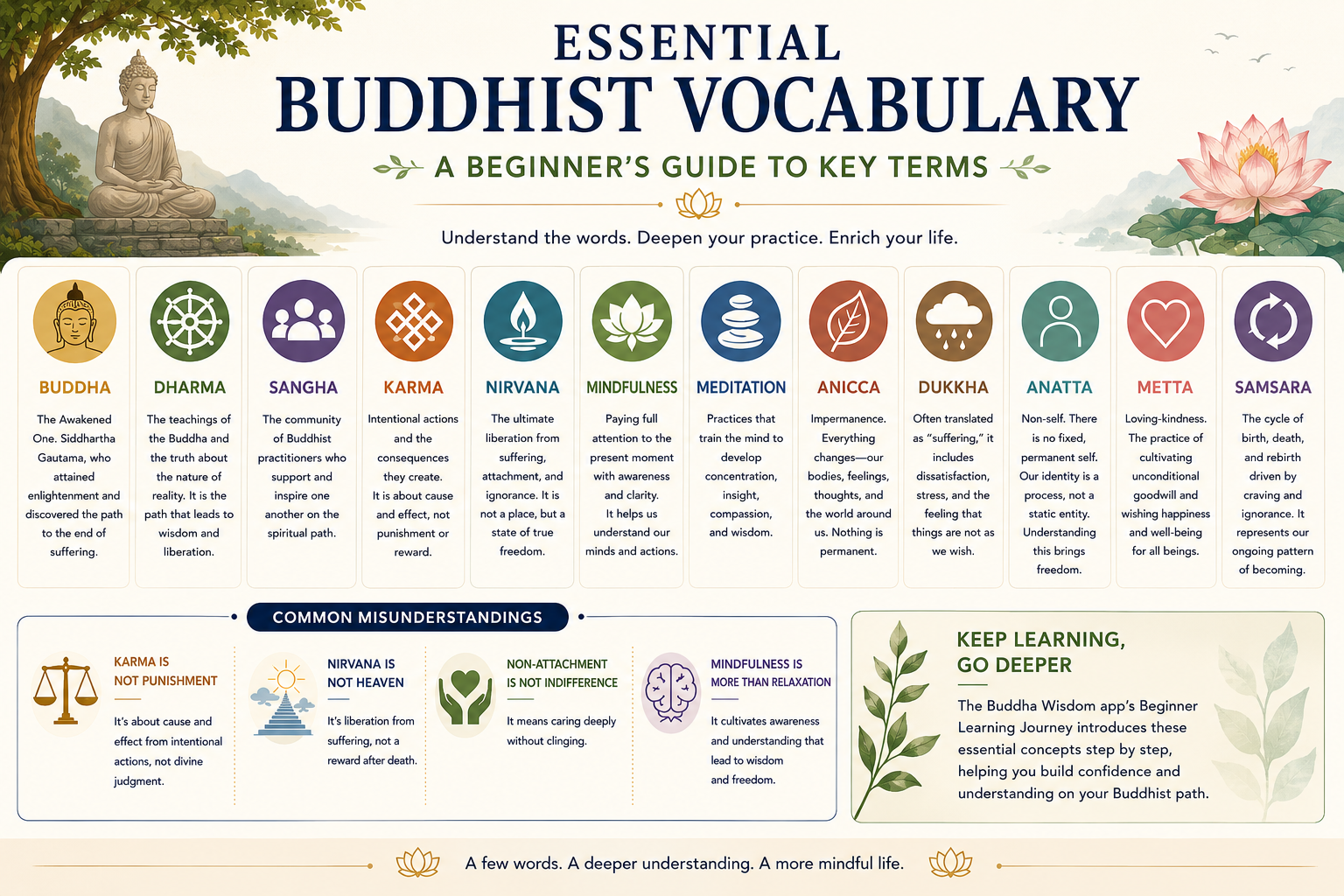
If you’ve ever started reading about Buddhism, you’ve probably encountered unfamiliar words like Dharma, Sangha, Anicca, or Nirvana and wondered where to begin.
The good news is that you don’t need to memorize dozens of ancient terms to understand Buddhism. Learning a small number of core concepts can make books, podcasts, and Buddhist teachings much easier to follow.
This beginner-friendly guide explains some of the most important Buddhist vocabulary in clear, everyday language.
Why Buddhist Terminology Can Feel Overwhelming
Many Buddhist texts use words from Pali or Sanskrit, languages that may be unfamiliar to modern readers.
At first glance, terms like Dukkha or Anatta can seem intimidating, but they represent ideas that describe universal human experiences rather than complicated philosophy.
Understanding a handful of key concepts provides a strong foundation for exploring Buddhism with greater confidence.
Essential Buddhist Terms Every Beginner Should Know
Buddha
The word Buddha means “the Awakened One.”
Although it often refers to Siddhartha Gautama, the historical founder of Buddhism, the title itself describes someone who has awakened to the true nature of reality.
Dharma
Dharma refers to the teachings of the Buddha and the path that leads to wisdom and liberation from suffering.
It can also describe the truth or the way things are.
Sangha
The Sangha is the community of Buddhist practitioners.
Traditionally, it referred to monks and nuns, but today it often includes lay practitioners who support one another on the path.
Karma
Perhaps no Buddhist concept is more misunderstood than karma.
Karma does not mean punishment or reward handed out by the universe.
Instead, it refers to intentional actions and the consequences they create. Our choices influence future experiences through cause and effect, encouraging personal responsibility rather than fear of cosmic judgment.
Nirvana
Nirvana is the ultimate goal of Buddhist practice.
It is not a heaven or physical place but a state of liberation from suffering, attachment, and ignorance.
Mindfulness
In Buddhism, mindfulness means paying careful attention to the present moment with awareness and clarity.
It is much more than a relaxation technique and forms an important part of the Buddhist path.
Meditation
Meditation is a collection of practices used to cultivate concentration, insight, compassion, and wisdom.
Different Buddhist traditions emphasize different meditation methods, but all aim to deepen understanding of the mind.
Anicca
Anicca is the Pali word for impermanence.
It teaches that all conditioned things are constantly changing, a principle that encourages flexibility and helps reduce attachment.
Dukkha
Often translated simply as “suffering,” Dukkha has a broader meaning.
It includes dissatisfaction, stress, and the sense that lasting happiness cannot be found by clinging to temporary experiences.
Anatta
Anatta, or non-self, teaches that there is no fixed, permanent, unchanging self.
Instead, our identity is constantly evolving through changing physical and mental processes.
Metta
Metta is usually translated as loving-kindness.
It is the practice of developing unconditional goodwill and genuine wishes for the happiness and well-being of oneself and others.
Samsara
Samsara refers to the ongoing cycle of birth, death, and rebirth described in Buddhist tradition.
More broadly, it represents the repetitive patterns of craving and dissatisfaction that keep beings trapped in suffering.
Frequently Misunderstood Buddhist Words
Many Buddhist concepts have entered popular culture but are often used inaccurately.
Karma is not punishment
Karma is about cause and effect arising from intentional actions, not supernatural rewards or punishments.
Nirvana is not heaven
Nirvana is liberation from suffering rather than a destination reached after death.
Non-attachment does not mean not caring
Buddhism encourages compassion and love while recognizing that clinging too tightly to people, possessions, or expectations often creates suffering.
Mindfulness is more than stress reduction
Although mindfulness can reduce stress, its deeper purpose is cultivating awareness and understanding that support wisdom and ethical living.
Why Learning Buddhist Vocabulary Matters
Learning Buddhist terminology isn’t about sounding knowledgeable or memorizing foreign words.
It’s about understanding ideas that can change the way you see everyday life.
When you know what concepts like impermanence, mindfulness, compassion, or karma actually mean, Buddhist teachings become much clearer and easier to apply in practice.
If you’re just beginning your exploration, a structured learning path can make the process feel much less overwhelming.
The Buddha Wisdom app includes a Beginner Learning Journey that introduces essential Buddhist concepts step by step, helping you build confidence before moving on to more advanced teachings.
Start With Understanding, Not Memorization
You don’t need to know every Buddhist term before you begin learning.
Start with a few key concepts, become familiar with their meaning, and allow your understanding to grow naturally over time.
As you continue exploring Buddhism, you’ll discover that these words are more than vocabulary—they represent practical insights into mindfulness, compassion, impermanence, and the nature of human experience.
Building a basic understanding of Buddhist terminology makes it easier to read books, follow teachings, and engage thoughtfully with the tradition. Rather than trying to memorize definitions, focus on how these ideas connect to everyday life and your own experience.