
Many people are surprised to learn that Buddhism is not a single, uniform tradition.
As Buddhism spread across Asia over more than two thousand years, it adapted to different cultures, languages, and historical circumstances. This led to the development of several major Buddhist schools and traditions.
For beginners, this diversity can seem confusing. If Buddhism is based on the teachings of the Buddha, why are there different schools at all?
The answer is that while Buddhist traditions may differ in their practices, texts, and cultural expressions, they share many of the same foundational teachings. Understanding these similarities and differences can help you navigate the Buddhist world with greater confidence.
Why Are There Different Schools of Buddhism?
After the Buddha’s death, his teachings were passed down through generations of practitioners.
As Buddhism spread from India into other parts of Asia, different communities developed their own interpretations, practices, and methods of teaching. Historical events, local cultures, and philosophical discussions also influenced how Buddhism evolved in different regions.
Over time, several major traditions emerged.
Although they vary in emphasis and style, they all trace their roots back to the teachings of the historical Buddha and share a commitment to reducing suffering and cultivating wisdom.
What Do All Buddhist Schools Have in Common?
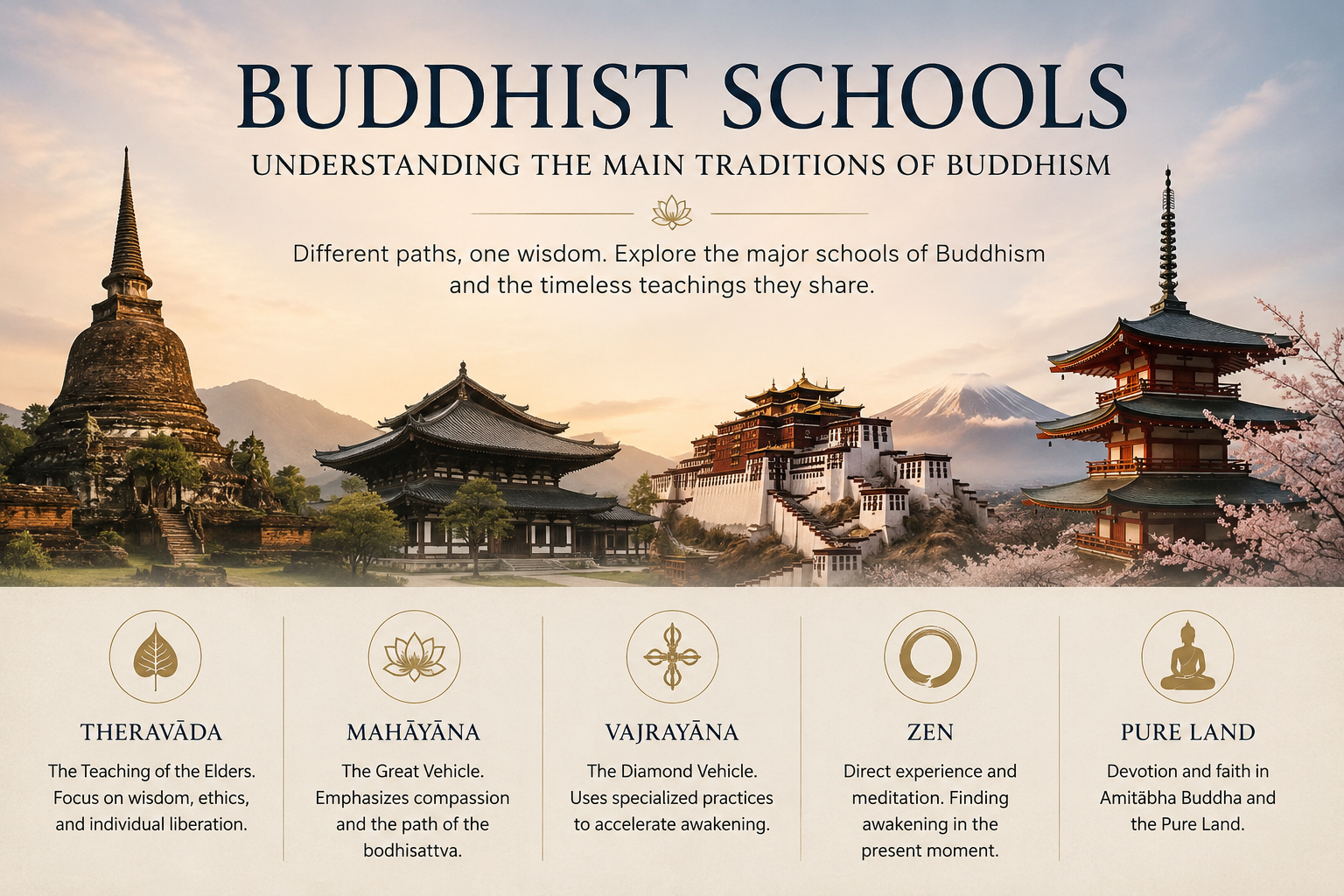
Despite their differences, most Buddhist schools share several core principles.
These include:
- Respect for the Buddha and his teachings.
- The Four Noble Truths.
- The Noble Eightfold Path.
- The importance of ethical conduct.
- The cultivation of mindfulness and wisdom.
- Compassion for all living beings.
For this reason, it is often more helpful to think of Buddhist schools as different paths within the same broad tradition rather than completely separate belief systems.
Theravāda Buddhism
Theravāda Buddhism is the oldest surviving Buddhist tradition and is often translated as “The Teaching of the Elders.”
It is most commonly practiced in:
- Sri Lanka
- Thailand
- Myanmar
- Laos
- Cambodia
Theravāda places strong emphasis on the earliest Buddhist scriptures and the individual’s path toward liberation through ethical conduct, meditation, and wisdom.
Many modern mindfulness and meditation practices popular in the West have roots in Theravāda traditions.
Mahāyāna Buddhism
Mahāyāna, meaning “Great Vehicle,” became the dominant form of Buddhism in much of East Asia.
It is widely practiced in:
- China
- Japan
- Korea
- Vietnam
Mahāyāna traditions emphasize compassion and the ideal of the bodhisattva—a person who seeks awakening not only for themselves but for the benefit of all beings.
This broad family of traditions includes several well-known schools, such as Zen and Pure Land Buddhism.
Vajrayāna Buddhism
Vajrayāna Buddhism developed from Mahāyāna traditions and is most closely associated with Tibet and the Himalayan region.
It is commonly practiced in:
- Tibet
- Bhutan
- Mongolia
- Parts of Nepal and India
Vajrayāna incorporates meditation, ritual, symbolism, and specialized practices intended to accelerate spiritual development.
The tradition is often known in the West through Tibetan Buddhism and teachers such as the Dalai Lama.
Zen, Pure Land, and Other Traditions
Within the major schools of Buddhism, many additional traditions have developed.
Zen Buddhism
Zen emphasizes direct experience, meditation, and personal insight.
Rather than focusing heavily on philosophical study, Zen encourages practitioners to cultivate awareness through disciplined practice and mindful attention to everyday life.
Pure Land Buddhism
Pure Land Buddhism emphasizes faith, devotion, and the aspiration to be reborn in the Pure Land of Amitābha Buddha, where conditions for awakening are believed to be especially favorable.
It is one of the most widely practiced forms of Buddhism in East Asia.
Other Traditions
Many other schools and lineages exist throughout the Buddhist world. Some focus primarily on meditation, others on study, devotion, ritual practice, or community life.
While their methods may differ, they all draw inspiration from the Buddha’s teachings.
Which Buddhist School Is Right for Beginners?
Newcomers often wonder which school they should choose.
In reality, there is no single correct answer.
Many people begin by exploring the basic teachings that are shared across traditions, such as mindfulness, compassion, impermanence, and the Four Noble Truths.
As their understanding grows, they may find themselves naturally drawn to a particular tradition based on its practices, community, or approach to learning.
For beginners, understanding the common foundations of Buddhism is often more important than deciding between schools.
A Shared Path With Different Expressions
The diversity of Buddhist schools reflects the many ways people have engaged with the Buddha’s teachings throughout history.
Theravāda, Mahāyāna, Vajrayāna, Zen, Pure Land, and other traditions each offer unique perspectives and practices. Yet all of them seek to cultivate wisdom, compassion, and freedom from suffering.
Rather than viewing these schools as competing versions of Buddhism, it can be helpful to see them as different expressions of a shared tradition.
By understanding what unites them as well as what distinguishes them, you can gain a deeper appreciation for the richness and diversity of Buddhism as a whole.
Where to Begin
If you’re new to Buddhism, start with the teachings that are common to all major traditions.
The Buddha Wisdom app includes a Beginner Learning Journey and Foundations Readings that introduce key concepts step by step. By building a strong understanding of Buddhism’s shared principles first, you’ll find it easier to explore the different schools and discover which approaches resonate most with you.